Give the things you say in passing a reliable place to land.
Customer hypothesis: when your hands are busy, you're walking, or you're mid-conversation, the cost of pulling out a phone, opening an app and typing means ideas and commitments get lost. NOVA One's first job is to make capturing nearly effortless, and to keep what's captured findable and actionable.
Who it's for first
We'll first validate with people who often have ideas or receive commitments while commuting, walking or juggling tasks: creators, independent professionals, and busy office workers managing their personal lives. High-frequency personal notes come first; shared family use will be evaluated later.
Why a necklace deserves to exist
When worn, the side key is easy to reach and capture doesn't depend on a phone. The round screen shows recording, saved and needs-confirmation states, and haptic reminders don't require you to keep checking a phone. Voice memos, smartwatches and earbuds each cover part of this need. Hardware is only worth pursuing if the necklace wins on reachability, comfort, social acceptance and completion rate.
Differentiation hypothesis
Wearable push-to-record devices already exist — for example, Plaud NotePin S uses a physical button, vibration and an indicator light to show recording status (official guide ↗). NOVA's angle is round-screen feedback, short personal notes, traceable original wording, and confirmed to-dos. Good looks alone don't prove demand.
Version one does three small things, well.
| Scenario | Example input | Result & boundaries |
|---|---|---|
| Capture an idea | “I want to make an AI necklace with a round screen.” | Keeps the original audio, transcript and topic tags. Search results link back to the original clip. |
| Keep a promise | “Remind me to buy flowers Friday at six.” | Extracts a to-do. Confirms the exact date, time and time zone before creating a reminder. |
| Get ready to leave | “Tomorrow, bring my ID, charger and the document.” | Builds a checklist. With no departure time, it saves the list and asks — it never creates a reminder on its own. |
Round-screen interaction
- Standby: screen off by default. A tap briefly shows the AI orb, connection and battery, using short, large-type status words.
- Recording: hold the side key to capture. A live waveform and red recording mark appear, with a buzz at start and end. The indicator must always match the actual microphone state.
- Saving: distinguishes “Saved on device”, “Waiting for phone sync” and “Sorted” — one success animation never hides an unfinished step.
- Review: complex content is confirmed on the phone. The round screen shows only short states like “Time needs confirming”, never long text.
- Reminders: confirmed reminders trigger a buzz and a short title. You lift the pendant to read it; screen orientation is a prototype validation item.
The pendant sits on your chest; we don't assume the wearer can keep looking down at it. The screen is for feedback and short information — full detail lives on the phone.
About the homepage demo
The three scenarios use preset text to show the capture and sorting flow. The demo never accesses a microphone, records audio, connects to a necklace, creates calendar events or sends notifications. Results exist only in the current page session.
The warmth of a round button. The precision of a device.
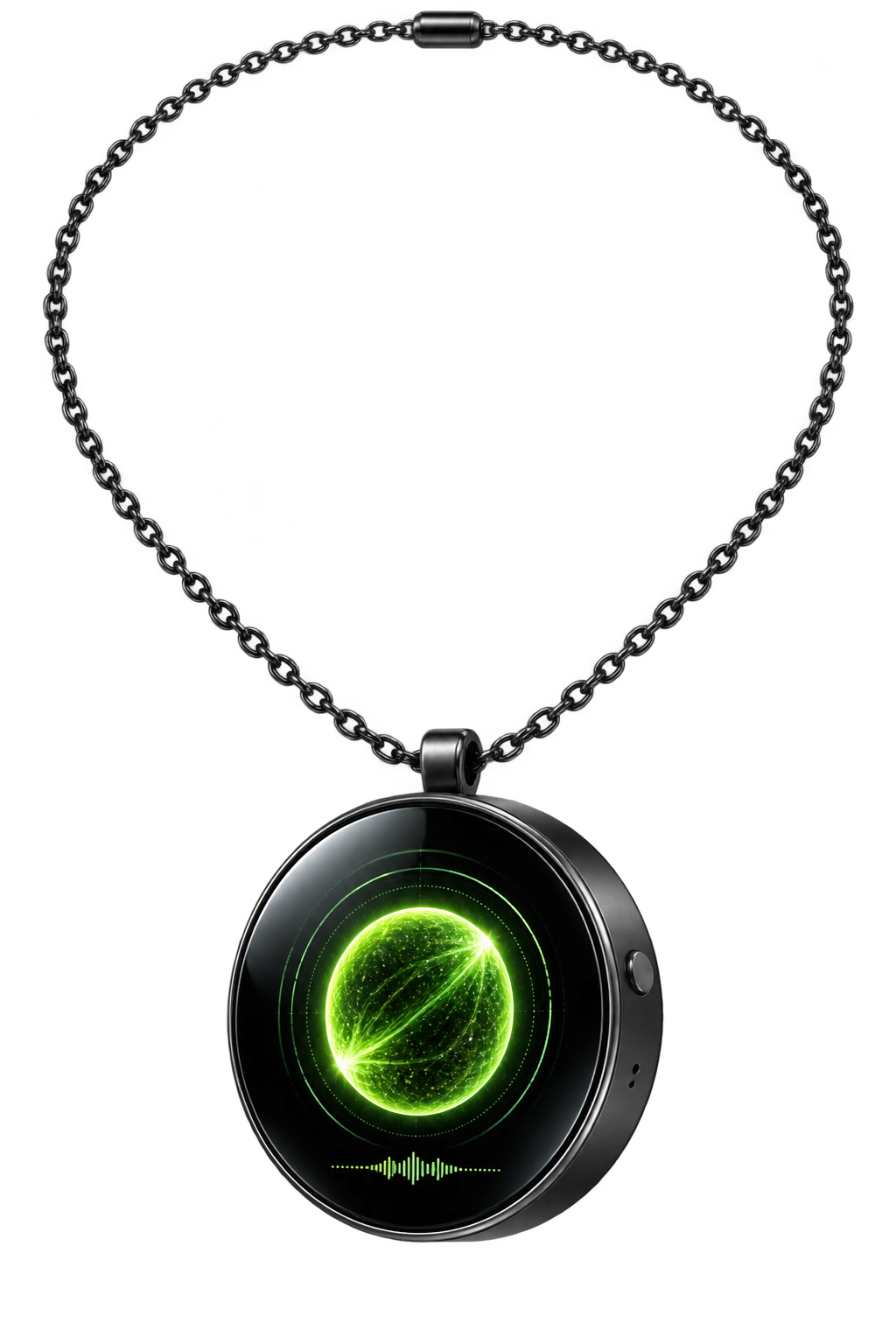
Form: a round metal pendant, a full circular display and a fine metal chain. Black glass and the green AI orb are the visual centre, framed by restrained metallic highlights. The side carries a tactile record key and microphone ports; the back has magnetic charging contacts. Placement of the status light and hardware mute switch goes through structural validation — concept renders don't replace engineering layout.
| Candidate spec | Target / direction | Must validate |
|---|---|---|
| Pendant size | About 38 mm diameter, about 10 mm thick | Stack-up of display, PCB, battery, microphone acoustic chamber and structure |
| Weight | Pendant under 35 g, excluding chain | Real materials, centre of gravity, swing on the chest and all-day comfort |
| Display | About 1.0–1.2 in round OLED; touch as a candidate | Supply, size, brightness, heat, power draw and burn-in risk |
| Connectivity | Bluetooth Low Energy + companion phone app | iOS / Android background limits, reconnection and sync reliability |
| Input / output | Dual-mic candidate, physical side key, haptics, screen status | Fabric rustle, wind noise, near/far distance, accidental presses, haptic perceptibility |
| Battery & life | About 250–350 mAh candidate; one day of mixed use | Define a test load first — 30 min recording and 40 ten-second wakes per day — then correct with measurements |
| Wear & charging | Adjustable chain, breakaway clasp, magnetic charging dock | Pull force, sweat, skin contact, charging temperature and drops |
Version one is for adults only. Water resistance, material composition, wireless certification and safety claims can only be published after testing and certification. This plan makes no claims about production battery life, ingress protection or medical function.
Keep the device simple. Let the phone carry the complexity.
Prototype order
- Build a bench prototype from a proven Bluetooth audio / MCU dev board, an off-the-shelf round display and microphones. First prove one short recording from button to phone.
- Support one phone platform first. Validate offline caching, that repeated syncs never create duplicates, and that saved status always matches reality.
- AI extraction only produces suggestions awaiting confirmation. If a time is missing, the transcript is uncertain or content conflicts, no reminder is created.
- Build a wearable prototype near the target size and weight, then evaluate custom PCB, power optimisation and enclosure tooling.
Offline and failure
Offline, audio is saved on the device with “Saved, waiting to sync”. Without a finished transcript, it never shows “Sorted”. If the phone is unavailable, no new AI reminders are promised. Reminders already synced to the necklace can fire from its local clock; disconnection, clock drift and time-zone changes need validation.
Version one scope
No camera, no continuous ambient listening, no phone calls, and no default takeover of third-party accounts. Long meeting recording and multi-speaker identification are out of the first round. Any future third-party actions will use official APIs with per-action authorisation.
It only records when you clearly start it.
- Intentional capture: recording happens only while the side key is held. No all-day recording and no hidden audio buffer. When others are involved, users must obtain appropriate consent first.
- Visible status: a red mark stays visible while recording, paired with haptics. A hardware interlock strategy is needed for software hangs, display faults and true microphone state.
- Physical control: a planned hardware switch cuts power to the microphones. Once off, software cannot re-enable capture — to be proven by testing.
- Data handling: audio and text are stored encrypted, and users can view and delete them. On-device and cloud processing are clearly separated; on-device transcription is only promised on verified phones.
- Minimal upload: before any online AI processing, users are told where data goes. Providers are configured to prohibit training and set clear retention periods — to be verified in contracts and implementation.
- Clear permissions: calendar, notifications and cloud processing are requested per feature. Payments, sending content and sign-ups always show the content first and wait for confirmation.
- Freedom to leave: cancelling a subscription never loses personal records. Export, unpair and device wipe are supported; any future sharing uses per-item consent.
Prove people need it. Then prove the hardware can do it.
Real-life interviews
Recruit about 20 target users. Observe when things get forgotten; compare phone recording, watch and necklace. Test chain length, swing and social acceptance with weighted mock-ups.
End-to-end short capture
Bench round screen and key, companion app, short-recording sync, AI extraction, user confirmation and reminders. Validate failure paths: offline, duplicate sync, missing dates, misrecognition.
All-day wear trial
A small wear trial. Measure time-to-capture, accidental presses, recording intelligibility, how people read the screen, fabric noise, weight and real battery life.
Continue, narrow or stop
Decide on custom hardware based on retention and reliability. If people love the look but don't capture, return to positioning — never go straight to tooling.
Candidate acceptance criteria (not yet tested)
- At least half of trial users still actively use it three or more days a week in week four — checked for incentive effects.
- In the same scenarios, median time to start a short capture is at least 50% faster than a phone; requires a measured comparison.
- No test recordings lost; after disconnects and repeat syncs, records reconcile completely, and critical save failures are clearly surfaced.
- Every formal reminder is user-confirmed; unclear times stay pending and no reminder is created unprompted.
- One day of battery under the defined mixed load, plus completed thermal, wear and pull-safety assessments.
Worth paying for, because it's worth wearing every day.
Pricing hypothesis: use ¥999 (about US$140) as one interview and willingness-to-pay test point, compared against lower and higher prices. No price is set. Display, electronics, structure, chain, charging dock, assembly, testing, channel, certification, warranty and return costs must be modelled first.
Basic local capture, export and the core capabilities of a purchased device come with the hardware. Cloud transcription quota and long-term cross-note insights may become an optional subscription — inference cost and usage frequency come first. The hardware must never lose basic capture after a subscription ends.
What exists today
An original AI necklace concept render, an interactive product homepage and this product plan. No real necklace, firmware, companion app or AI service has been delivered. The homepage takes no pre-orders or payments, and collects no visitor emails.